
The Moment Everything Changed
In the fall of 2021, while most of Canada was still navigating pandemic protocols and wondering what "return to normal" might look like, Jazz Pabla sat in his office at Kelowna City Hall with a different question entirely.
Pabla, the city's Chief Information Officer, had just finished a call with Microsoft. The tech giant wanted to explore how artificial intelligence could transform municipal services. Most cities would have politely declined or filed the idea for "someday." Pabla said yes.
"We wanted to understand AI's potential before the hype cycle," he would later explain. "That head start gave us time to build the right foundation."
It was a prescient decision. Sixteen months later, ChatGPT would launch and trigger a global AI gold rush. Municipalities everywhere would scramble to figure out what this technology meant for them. Kelowna would already be serving citizens with it.
The Quiet Crisis Nobody Talked About
To understand why Kelowna's story matters, you need to understand what was happening in their building permit department in 2021.
Kelowna isn't just a pretty Okanagan city with wineries and beaches. It's Canada's fastest-growing metropolitan area, having added roughly 50,000 residents since 2016. With growth comes development—and with development comes paperwork. Lots of it.
The city's planning department was drowning.
Every day, phones rang with the same questions, asked hundreds of times: *What can I build on my property? Do I need a permit for a pool? What are the setbacks for a carriage house?*
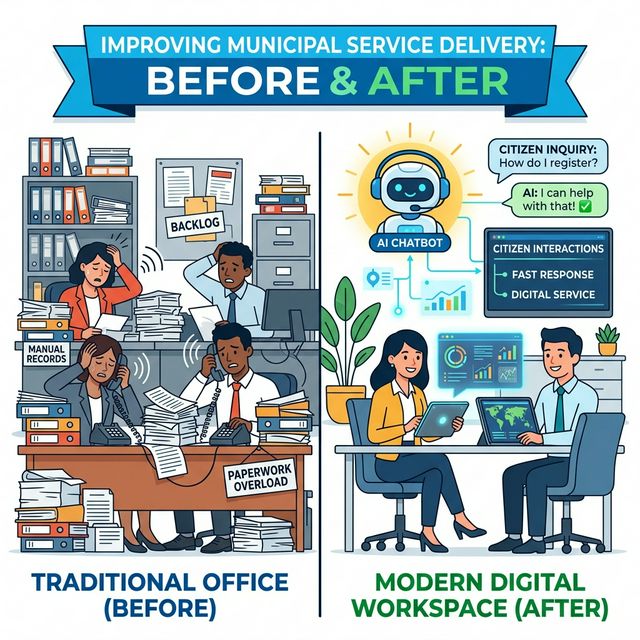
Staff would patiently explain zoning bylaws, setback requirements, and permit processes to one caller, hang up, and immediately answer the same questions again. Meanwhile, complex development applications sat in queues. Planners—highly trained professionals who should have been designing neighborhoods and reviewing architectural plans—were spending their days acting as human FAQ machines.
"It wasn't sustainable," recalls a senior planner who asked not to be named. "We were reactive. Every day felt like we were falling further behind."
The frustration went both ways. Residents couldn't get answers evenings or weekends. They'd wait on hold, get transferred between departments, and sometimes still leave confused. For contractors working on tight timelines, the delays were costly. For homeowners trying to understand what they could build, the process felt opaque and intimidating.
Most cities face some version of this problem. Growth creates demand. Demand creates backlogs. Backlogs create frustrated citizens and burned-out staff. It's the quiet crisis of modern municipal government: everyone wants better service, but nobody wants higher taxes to hire more people.
What made Kelowna different was what they decided to do about it.
Starting With Questions, Not Technology
Here's where Kelowna's approach diverges from the typical "we need an app" digital transformation story.
When Pabla's team started exploring AI in late 2021, they didn't begin by shopping for software. They began by asking hard questions.
- How do we ensure AI doesn't train on citizen data?
- How do we keep responses within official city information?
- How do we maintain transparency about what this technology is actually doing?
These weren't technical questions. They were ethical ones. And they led Kelowna to an unlikely partner: the Montreal AI Ethics Institute.
Working with the institute, Kelowna developed something rare in municipal government—a comprehensive AI governance framework before deploying a single chatbot. The framework addressed:
- Data sovereignty: Clear policies on what data sources AI could access and which departments controlled them
- Transparency: A public registry documenting every AI data source and how it was used
- Privacy protection: Technical guardrails preventing AI models from training on government data
- Human oversight: Clear boundaries between what AI could handle and what required professional judgment
"We wanted to build trust first," Pabla explains. "If citizens don't trust the technology, it doesn't matter how sophisticated it is."
This governance-first approach meant Kelowna's AI journey would be slower than some. But it also meant that when they did deploy technology, they wouldn't face the backlash and skepticism that has derailed AI projects in other jurisdictions.
The Snow Plow That Started It All
If you're expecting Kelowna's AI story to begin with something glamorous, prepare to be disappointed. It began with snow removal.
In the winter of 2022, Kelowna launched its first AI-powered service: a chatbot that could answer questions about snow plow schedules.
Not housing policy. Not economic development. Snow plows.
The choice was deliberate. Snow removal was simple enough to work reliably, visible enough that citizens would actually use it, and low-stakes enough that failures wouldn't cause major problems. If the chatbot got confused about when Priority 1 roads were being plowed, nobody's life was ruined.
The results surprised even the skeptics.
The snow plow chatbot achieved 80% accuracy on real-time questions. It handled over 1,000 calls that would have otherwise required staff intervention. Residents got instant answers at 10 PM about when their street would be cleared. Staff stopped fielding repetitive questions and could focus on actually coordinating snow removal.
More importantly, the snow plow chatbot proved something crucial: AI could work in municipal government.
"That first project was everything," remembers a member of the implementation team. "It wasn't fancy, but it worked. It gave us credibility. It gave us proof."
The success of a humble snow plow chatbot opened doors—and wallets. Based on demonstrated results, Kelowna secured $1.1 million in additional funding for strategic technology initiatives. The city had earned the right to think bigger.
From Snow Plows to Building Permits
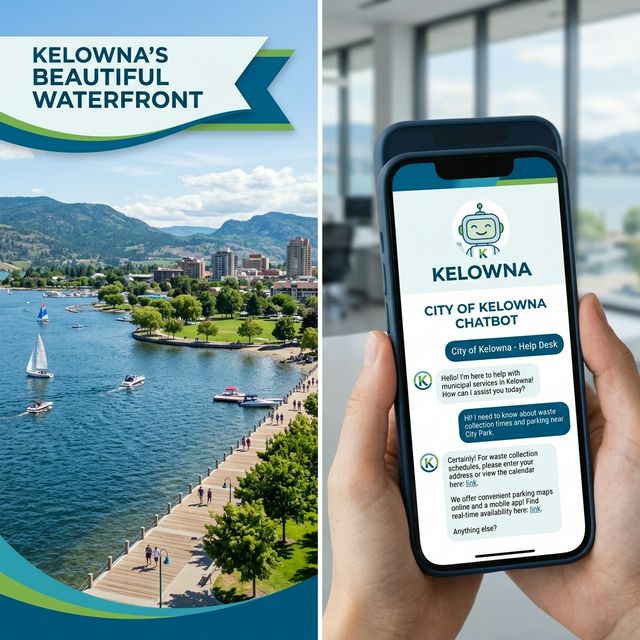
With credibility established and funding secured, Kelowna moved to the project that had been the real goal all along: transforming the building permit process.
Launched on October 3, 2023, Kelowna's building permit AI represented a significant leap in sophistication from the snow plow chatbot. This wasn't just answering FAQs anymore. The system could:
- Answer complex zoning questions using the city's official bylaws
- Provide property-specific information by integrating with GIS mapping data
- Guide users through permit requirements based on their specific situation
- Offer two distinct modes: "guided journeys" for first-time applicants and generative AI for experienced contractors
The technology stack was deliberately cohesive: Microsoft Azure OpenAI Service for the language model, Zammo.ai for the conversational interface, Azure Cognitive Search for document indexing, and Microsoft Power Platform for workflow automation. Everything stayed within the Microsoft ecosystem—not because Kelowna lacked imagination, but because integrated systems meant integrated security, simplified procurement, and staff who only needed to learn one platform.
But the technology was only half the story. What made Kelowna's implementation work was how they introduced it to the organization.
Planners weren't replaced by AI; they were freed by it. The system was explicitly designed to handle routine queries that didn't require professional judgment, allowing actual planners to focus on complex applications, neighborhood design, and the high-value work they'd been trained to do.
"The best part," says one planner, "is that we're not the bad guys anymore. We're not the people saying 'no' or making you wait on hold. The chatbot handles the frustration. We handle the solutions."
The Results Speak
By 2024, the numbers told a compelling story:
But numbers only capture part of the impact. The real story is in the intangibles:
- Residents who can get accurate information at 11 PM on a Saturday about whether their project needs a permit
- Planners who can focus on complex applications instead of answering the same basic questions repeatedly
- Contractors who get faster, more consistent answers, keeping projects on schedule
- A city that's growing rapidly but somehow managing to serve citizens faster, not slower
The transformation didn't go unnoticed. Kelowna received the IABC Gold Quill Award in 2023 for excellence in communication, and CIO Jazz Pabla captured the Peter Bennett Award from MISA Canada in 2024 for outstanding municipal IT leadership.
More importantly, Kelowna proved that municipal AI wasn't theoretical. It was possible. It was working. And it was happening in a mid-sized Canadian city, not just global metropolises with unlimited budgets.
What Made Kelowna Different: Six Lessons
As other municipalities study Kelowna's success, several factors stand out:
1. Leadership That Leads
Pabla's team didn't wait for permission to innovate. They built a culture where exploring new technology was encouraged, not punished. During the pandemic, when other municipalities struggled with turnover, Kelowna's IT team had one of the lowest attrition rates in Canadian local government.
"Next-generation workers leave stagnant environments," Pabla observed. "We built a place where they want to stay."
2. Strategy Before Software
Kelowna developed a formal AI and automation strategy that identified 100+ potential initiatives and quantified $1.4 million in annual savings. They created an automation center of excellence and built governance dashboards before writing a single line of chatbot code.
3. Ethics as Foundation
The partnership with the Montreal AI Ethics Institute wasn't a press release stunt. It shaped every technical decision that followed. Kelowna's public AI registry and transparent governance model became a template for responsible municipal AI deployment.
4. Integrated Ecosystem
Rather than cobbling together solutions from multiple vendors, Kelowna committed to Microsoft's integrated platform. This meant consistent security, simplified training, and easier scaling across departments.
5. Proof Before Promotion
The snow plow chatbot wasn't glamorous, but it was provable. Kelowna demonstrated value before asking for resources, building organizational trust one successful project at a time.
6. Augmentation, Not Replacement
Every communication about Kelowna's AI emphasized the same message: this technology handles routine tasks so humans can handle complex ones. Planners weren't being automated; they were being empowered.
What's Next
Kelowna isn't resting on its success. The roadmap ahead includes:
- City-wide 311 AI expansion: A unified chatbot for all municipal services
- Development application automation: Canada's first AI tool for reviewing development applications
- Digital twin technology: GIS-based wildfire response simulation
- Geospatial AI: Impervious surface mapping for stormwater utility fees
The foundation built over three years is now scaling across the entire organization.
For Other Municipalities: What Kelowna's Story Means for You
If you're reading this from a smaller municipality, or one without Kelowna's resources, you might be thinking: *That's inspiring, but we could never do that.*
Here's what you need to know:
Kelowna had advantages most municipalities don't have.
- A forward-thinking CIO who started exploring AI before it was trendy
- 40-person IT staff and enterprise Microsoft agreements
- Years to develop governance frameworks and custom solutions
- Resources to partner with AI ethics institutes and specialized development firms
But the core principles that made Kelowna successful are accessible to everyone:
- Start with the problem, not the technology. Kelowna didn't implement AI because it was cool. They implemented it because planning staff were overwhelmed and residents couldn't get answers.
- Governance isn't optional. The municipalities that will succeed with AI are the ones that take ethics, transparency, and data protection seriously from day one.
- Prove value early. You don't need to transform everything at once. One successful chatbot can build the credibility and trust you need for larger initiatives.
- Think ecosystem. Whether you choose Microsoft, Google, or specialized municipal AI platforms, integrated systems are easier to secure and scale than fragmented solutions.
- Focus on augmentation. The best municipal AI doesn't replace staff; it makes them more effective. Frame your projects accordingly.
The playing field is leveling. Three years ago, Kelowna had to build custom solutions with specialized development partners. Today, municipal-specific AI platforms exist that come pre-configured with local knowledge, compliance frameworks, and governance guardrails.
The barrier to entry for municipal AI has never been lower. The technology has matured. The governance models exist. The proof points—from Kelowna and others—demonstrate that this works.
What hasn't changed is the need for leadership, strategy, and a clear-eyed focus on serving citizens better.
Kelowna showed us what's possible. The question for your municipality is: what will you do with that knowledge?
Resources and Further Reading
Ready to start your municipality's AI journey?
The Municipal AI Spotlight series celebrates Canadian municipalities leading innovation. TrueNorth Civic AI provides the compliant, secure platform to make it happen for your city.
Explore TrueNorth