
The Promise and Pitfall of Enterprise AI
Microsoft Copilot. Google AI. ChatGPT Enterprise. These powerful tools promise to transform how organizations work. For Canadian municipalities, however, there's a critical problem: these solutions were never built for the public sector.
As municipalities grapple with tight budgets, staffing challenges, and increasing demands for digital services, AI seems like an obvious answer. But adopting generic enterprise AI without understanding the compliance, privacy, and operational gaps can expose municipalities to significant risk.
This article explores why specialized municipal AI — not generic enterprise solutions — is essential for Canadian cities, towns, and regional districts.
1. Data Residency: A Non-Negotiable Requirement
FOIPPA and Municipal Obligations
British Columbia's Freedom of Information and Protection of Privacy Act (FOIPPA) applies directly to municipalities as public bodies. The law establishes guidelines to ensure that personal information under a public body's custody is protected through resident storage in Canada.
This means a compliant AI system should offer:
- Primary storage in secure Canadian data centres
- Encrypted and restricted prompt transmissions
- Secure global endpoint options that do not train on municipal data
gavelThe CLOUD Act Problem
While cloud infrastructure located in Canada mitigates physical data exposure, local governments must remain aware that any US-headquartered cloud provider is subject to the US CLOUD Act. TrueNorth transparently discloses this residual risk and mitigates it through Customer-Managed Encryption Keys (CMEK) and strict data retention controls, whereas generic solutions often ignore this jurisdictional complexity.
2. Generic AI Doesn't Understand Municipal Workflows
The Knowledge Gap
When a resident asks about permit requirements, they're not looking for generic information — they need answers specific to their municipality's zoning bylaws, building codes, and application processes.
Generic enterprise AI has no knowledge of:
- Building permit applications in your jurisdiction
- Zoning regulations and variance processes
- Bylaw enforcement procedures
- Public works project approvals
- Canadian municipal governance structures (council, committees, provincial upload)
Real Results from Specialized Solutions
| Municipality | Solution | Impact |
|---|---|---|
| Kelowna, BC | Microsoft AI chatbot | 20-40% staff time savings on permit inquiries |
| Kawartha Lakes, ON | municiPal AI (specialized) | First live Canadian municipal AI implementation (Oct 2025) |
The Kelowna result required significant customization. Most municipalities don't have the IT resources for this.
TrueNorth comes pre-loaded with municipal knowledge. No customization required.
3. Compliance Gaps That Cost More Than You Think
Missing Certifications
Generic enterprise AI lacks:
- FOIPPA compliance built-in — you must configure this yourself
- PIPEDA accountability frameworks — required for any data processing
- Canadian security certifications — no FedRAMP equivalent
- Audit trail capabilities — essential for public sector transparency
Ontario's Bill 194: A Preview of Coming Requirements
In December 2024, Ontario passed Bill 194 — the first hard law in Canada regulating public-sector AI use. It requires:
- Formal accountability frameworks
- Disclosure of AI use to affected persons
- Incident reporting requirements
Similar legislation is expected across other provinces. Generic enterprise AI wasn't designed to meet these requirements. Specialized municipal AI must.
The Audit Trail Problem
When a resident disputes a permit decision, your municipality must be able to show exactly what information was used, what recommendations were made, and when. Generic AI often operates outside standard logging systems — creating legal and operational risk.
4. Real-World Examples: When Generic AI Fails
US House of Representatives Bans Microsoft Copilot (March 2024)
The US House banned Microsoft Copilot over concerns that it could expose sensitive data to non-approved cloud services. The ban wasn't about Microsoft specifically — it was about the inherent risks of generic enterprise AI in government environments.
Samsung's Data Leak Incident
Samsung learned a costly lesson: employees leaked proprietary code to ChatGPT, exposing corporate secrets. In a municipality, the equivalent could be confidential staff reports, citizen personal information, or strategic planning documents.
Data Leakage Risks
Even when users have permission to access information, AI tools can surface data they shouldn't encounter — creating accidental exposure. For municipalities handling sensitive citizen data, this is unacceptable.
5. The Hidden Costs of "Enterprise" Solutions
Configuration Costs
Getting Microsoft Copilot or Google AI FOIPPA-compliant isn't a flip-of-the-switch operation. You'll need:
- Privacy impact assessments
- Data residency configuration
- Custom audit logging
- Staff training on municipal-specific use cases
Ongoing Compliance Burden
Generic AI providers update their systems regularly. Each update could affect data residency, compliance status, or feature availability. Your IT team must continuously monitor and adjust.
The True Cost Comparison
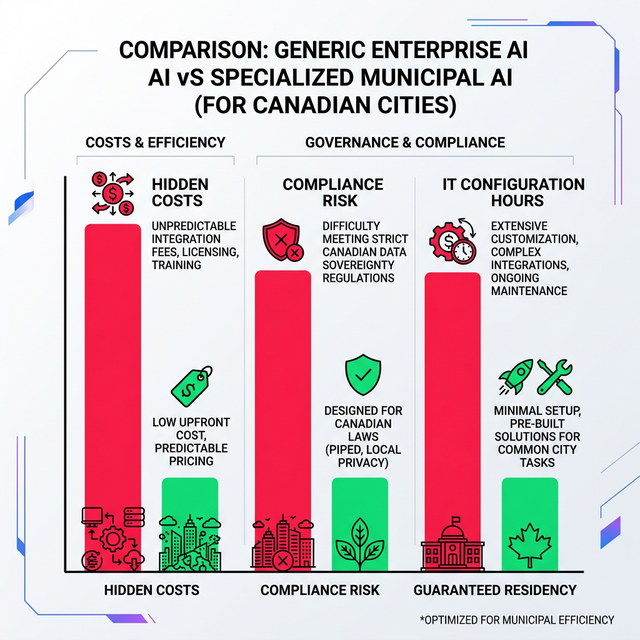
Figure 1: The true cost of self-configuring generic AI vs. choosing specialized municipal platforms.
Why TrueNorth Civic AI Was Built Different
TrueNorth addresses every gap identified above:
- check_circleCanadian Data Residency — Documents and database records are stored residently in Canada
- check_circleFOIPPA/PIPEDA Compliant — Built for BC and federal requirements
- check_circleMunicipal Knowledge — Pre-trained on municipal workflows, permits, bylaws
- check_circleAudit-Ready — Complete logging for freedom of information requests
- check_circleNo Configuration Required — Start helping residents immediately
Conclusion: The Right Tool for the Job
Generic enterprise AI is powerful — but power without municipal context is liability. Data residency laws, privacy requirements, and operational complexity make specialized solutions essential.
Municipalities that choose generic AI for cost savings often pay more in configuration, compliance, and risk management. Those that choose specialized AI get started faster, stay compliant, and better serve their residents.
The question isn't whether your municipality needs AI.
It's whether your AI is built for municipal government.